Notice: With the Laurelin server shutting down, our website will soon reflect the Meriadoc name. You can still use the usual URL, or visit us at https://meriadocarchives.org/
Maldrath
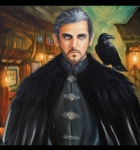
Lord Maldrath Halfsmile
| Name | Maldrath |
|---|---|
| Status | Active |
| Occupation | Running The Half Cricle Organization |
| Age | Late middle age |
| Race | Man |
|---|---|
| Residence | Bree Land |
| Kinship |
| Outward Appearance | Maldrath Halfsmile is a lean, sharp-featured man with piercing grey eyes that seem to unearth secrets with a glance. His short dark hair, streaked with grey, is neatly kept, and his trimmed beard frames a face marked by intellect and cunning. Always dressed in dark, practical attire, his raven-feathered cloak drapes his shoulders, adding an aura of danger and mystery. His faint, unsettling half-smile rarely leaves his lips, leaving those who meet him both intrigued and wary. |
|---|
Background
Maldrath Halfsmile:
Born under the watchful shadow of Pelargir’s bustling harbors, Maldrath entered the world in a home of intellect and ambition. His father, Calrion, was a diplomat, a man whose honeyed words smoothed disputes between feuding lords but whose own ambitions remained stifled by the currents of Gondor’s rigid hierarchy. His mother, Elenwen, was a scholar, her days spent poring over the crumbling tomes of Númenórean lore. Their union was one of purpose rather than affection—a partnership driven by a shared belief that knowledge and cunning could shape the world. They poured their hopes into their son, who quickly proved to be more than they had bargained for.
From an early age, Maldrath displayed an unnerving ability to read people. Where others saw faces and gestures, he saw weaknesses and desires, the invisible strings that moved men’s hearts and minds. His sharp grey eyes, always watchful, missed nothing. His questions, though innocently framed, carried an edge that unsettled even his parents. Why did men hoard gold yet speak of virtue? Why did lords demand fealty while breaking their own oaths? These musings hinted at a mind already dissecting the hypocrisies of the world, a boy whose curiosity was matched only by his ambition
At fifteen, Maldrath was sent to Minas Tirith, where the libraries of Gondor awaited him. The White City, its grandeur fading under the weight of years, offered more than just books—it offered power, hidden within the yellowed pages of history and the whispers of courtly intrigue. Maldrath excelled in his studies, mastering the ancient tongues of Númenor and Harad, delving into Gondorian law, and debating strategies of war with scholars twice his age. Yet, what set him apart was his gift for manipulation. Professors who dismissed him as a precocious youth soon found themselves ensnared in his arguments, while his peers avoided him, wary of his uncanny ability to unearth their fears.
As he grew older, Maldrath’s disillusionment with Gondor deepened. The nobility draped themselves in honor, yet their deeds were driven by greed. The laws were written to protect the weak, but only when it suited the strong. To Maldrath, honor was nothing more than a mask for hypocrisy, a tool used to restrain those who lacked the wit to wield true power. That power, he realized, lay not in banners or swords but in the ability to bend others to one’s will.
By his mid-twenties, Maldrath had risen to prominence as a diplomat, a rising star in the Steward’s court. His silver tongue brokered treaties and quelled disputes, earning him both respect and quiet resentment. Yet his ambition, like a storm gathering on the horizon, drove him to take risks. Believing that Gondor’s survival required bold action, Maldrath secretly negotiated with the Corsairs of Umbar, offering trade routes in exchange for redirecting their raids toward Mordor’s supply lines. It was a calculated gambit, one he believed would strengthen Gondor while weakening the Dark Lord’s grasp on the south.
But the court was a treacherous sea, and Maldrath’s rivals seized upon his dealings, branding him a traitor. The Steward’s judgment was swift. Stripped of his titles and cast out of Gondor, Maldrath became a fugitive, his name a stain upon his family’s honor. His parents disowned him, and the world he had sought to shape cast him into the wilderness, his ambitions shattered but his will unbroken.
For months, Maldrath wandered north, where whispers spoke of Forochel, the icy domain of the Lossoth. Legends of Númenórean relics hidden in the frozen wastes kindled a flicker of hope within him. If he could recover such treasures, he might yet reclaim his place in Gondor—or forge a new path entirely. In Forochel, he encountered the Lossoth, a reclusive and mistrustful people. Posing as a wandering scholar, Maldrath won their trust with his knowledge of their lore, learning their secrets: hidden paths through the ice, the locations of sacred grounds, the legends of their ancestors.
But Forochel was barren of the relics he sought, and Maldrath’s hope turned to bitterness. Desperate to salvage something from his journey, he betrayed the Lossoth, selling their secrets to the Guaradan, wolf-like tribes who had long sought to dominate the Snowmen. The Guaradan, impressed by his cunning, named him Korppi, their word for raven—a creature they revered for its intelligence and cruelty. The Lossoth cursed his name, but Maldrath had already moved on, carrying with him a lesson more valuable than any relic: power lay not in symbols or treasures but in the ability to control people’s fears and desires.
Maldrath’s journey eventually brought him to Bree, a town rife with opportunity for a man of his talents. Its underworld was a fractured web of brigands, gamblers, and outcasts, all pursuing their own interests without direction. To Maldrath, they were tools waiting to be sharpened. He began by offering solutions no one else could. A farmer plagued by wolves found his flock restored—for a price. A merchant robbed on the Greenway recovered his goods—but paid handsomely for the service. A noble, desperate to recover a stolen heirloom, turned to Maldrath when the guards refused to help. Each favor was a contract, and each contract was an opportunity.
Maldrath did not fulfill these contracts himself. Instead, he auctioned them in secret to mercenaries, brigands, and sellswords, awarding the job to the lowest bidder and pocketing a share of the gold. His system was efficient, profitable, and ruthless. Those who succeeded earned their payment and his favor. Those who failed faced penalties, from forfeiture of their earnings to exile—or worse. Through these contracts, Maldrath built a network, binding his clients and contractors alike to him through mutual need and fear of reprisal.
To consolidate his power, he established The Hound’s Prowl, an underground arena where fighters clashed for gold and glory. The arena became more than a den of blood and bets—it became the heart of Bree’s underworld, a place where alliances were forged, contracts exchanged, and fortunes made. The gold flowed freely, and with it came influence. The Half-Circle, Maldrath’s network of mercenaries, informants, and outcasts, grew into a shadowy empire bound not by loyalty but by necessity.
Through it all, Maldrath remained an enigma. His faint, unsettling half-smile—a relic of his days as an exile—rarely left his lips, a reminder that he viewed the world as a game and its people as pieces to be moved. To the desperate, he was a savior. To the ambitious, an opportunity. To his enemies, a shadow they could neither predict nor escape. Maldrath Ravencloak, the man once cast out by Gondor, had become something far more dangerous: the master of a web of secrets, debts, and whispered fears. And like the raven that had become his namesake, he watched from the shadows, ever hungry, ever patient, ever ready to strike.
| Friends | |
|---|---|
| Relatives | |
| Rivals/Enemies |
| Loves | |
|---|---|
| Hates | |
| Motivation | |
| Quotes |